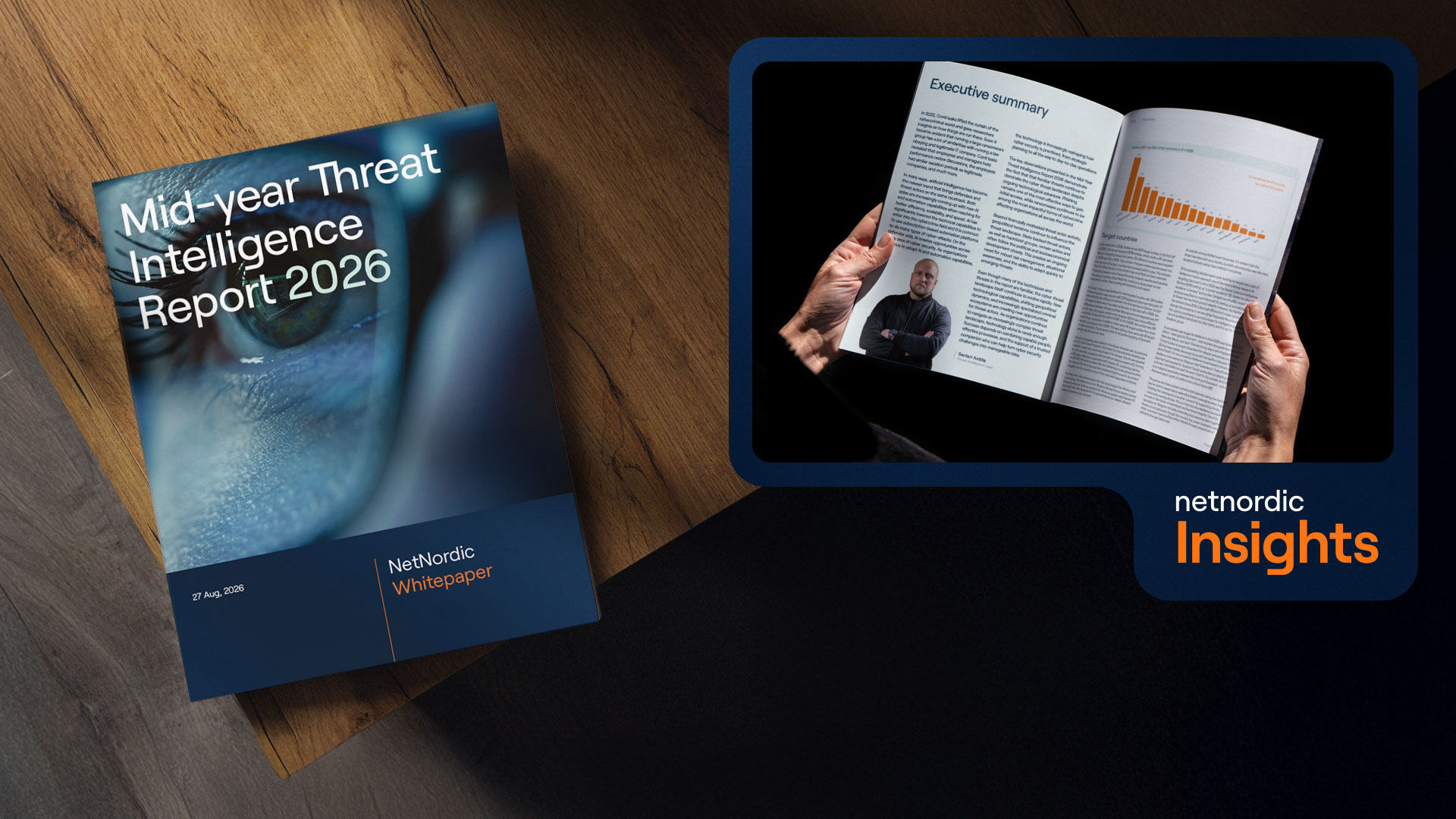
Mid-Year Threat Intelligence Report 2026
Unlock whitepaper
Unlock whitepaper
Cyber Threat Trends Shaping 2026: Ransomware, AI-Driven Phishing, Geopolitical Cyber Operations and Hybrid Threats
The cyber threat landscape in 2026 continues to evolve at an unprecedented pace. Organizations are facing increasing ransomware activity, more convincing phishing attacks, growing geopolitical instability, and an expanding range of hybrid cyber threats.
The NetNordic Mid-Year Threat Intelligence Report 2026 analyzes the key cybersecurity trends observed during the first half of the year and provides intelligence-driven insights into how threat actors, attack techniques, and cyber risks are evolving across Europe and globally. The report combines threat intelligence research, Security Operations Center observations, and analysis of real-world cyber incidents to help organizations prepare for the months ahead.
Why Cybersecurity Leaders Should Read This Report
Today’s cyber threats are no longer isolated technical challenges. As a result, security teams must understand not only how attacks occur, but also why organizations become targets and how the threat landscape is changing around them.
Modern attacks increasingly combine:
- Ransomware operations
- Hactivism and DDoS operations
- AI-assisted phishing campaigns
- Geopolitically motivated cyber activity
- Identity-based attacks
- Information and influence operations
Key Cybersecurity Trends Covered In The Report

4644
Listed ransomware victims globally during the first half of 2026.
Ransomware threats continue to increase
Ransomware remains one of the most significant cyber threats facing organizations. The report examines how ransomware activity has evolved during the first half of 2026, which industries are most heavily targeted, how victim distribution is changing across regions, and which threat groups are driving current trends. The analysis reveals notable shifts in targeting patterns and provides insight into what organizations should expect during the second half of the year.
Manufacturing continues to be among the most targeted sectors, while ransomware groups continue to expand their operations globally.
AI is changing the phishing threat landscape
Phishing remains one of the most commonly used attack vectors, but the techniques used by threat actors are becoming increasingly sophisticated.
The report explores the latest phishing trends observed by NetNordic SOC analysts:
- AI-assisted phishing campaigns
- Social engineering trends
- Phishing-as-a-Service (PhaaS)
- Device code phishing
- QR-code phishing attacks
- Identity-focused attack techniques
Threat actors are increasingly leveraging trusted platforms, business workflows, and highly personalized lures to improve attack success rates.

18%
Increase in ransomware victim listings compared to the first half of 2025.

Geopolitical events are increasing cyber risk
Cybersecurity can no longer be viewed independently from global events. Conflicts, geopolitical competition, hybrid influence operations, and economic uncertainty are increasingly reflected in cyberspace.
The report examines how developments in Europe and globally are influencing threat actor behavior, organizational risk exposure, and the broader cyber threat landscape. It also highlights why organizations must continuously evaluate their position within an increasingly dynamic threat environment.
Organizations that fail to understand their position within the broader geopolitical threat landscape may overlook significant business and cyber risks.
Hacktivism and hybrid threats remain active
State-aligned and politically motivated groups continue to use cyber operations to amplify narratives, create disruption, and influence public perception.
This year’s report includes an extensive analysis of one of the most active pro-Russian hacktivist ecosystems and explores how distributed denial-of-service attacks, information operations, and emerging tactics are being used to support broader geopolitical objectives.
17%
Increase in phishing-related incidents observed by NetNordic SOC compared to the previous year.

1870
Organisations targeted by the hacktivist group NoName057 in H1 2026.
Building cyber resilience in an age of uncertainty
While new technologies and attack methods continue to emerge, the report demonstrates that many successful attacks still exploit weaknesses in security fundamentals.
From threat visibility and security awareness to identity protection and attack surface management, the report offers practical insights into how organizations can strengthen their cyber resilience against evolving threats.
Why this report matters
Cyber threats are no longer isolated technical issues. They are increasingly connected to geopolitics, economic uncertainty, supply chains, and business operations.
Organizations that understand how attackers are adapting their techniques, targeting priorities, and operational models are better positioned to reduce risk and make informed security decisions.
The Mid-Year Threat Intelligence Report 2026 helps cybersecurity leaders, IT decision-makers, and business executives understand not only what is happening today, but also what developments are likely to shape the threat landscape during the remainder of the year.
This report is designed for:
- CISOs
- CIOs
- IT Directors
- Security Managers
- Risk and Compiance Leaders
- Digital Transformation Leaders
- Security Operations Teams
- Executive Decision-Makers
Anyone responsible for protecting organizational assets, managing cyber risk, or supporting business resilience will benefit from the intelligence and analysis included in this report.
About NetNordic Threat Intelligence
NetNordic Threat Intelligence continuously monitors cyber threats, adversary behaviour, ransomware activity, phishing campaigns, geopolitical developments, and emerging attack techniques affecting organizations across Europe and the Nordics.
Our analysts combine threat intelligence, incident response experience, digital forensics, and Security Operations Center insights to identify meaningful developments in the evolving cyber threat landscape.
Author

About Nicolas Samáneh
Nicolas Sámaneh is Associate Director of NetNordic Cyber Defence Services. He leads and develops cyber defense services with a focus on threat intelligence, security monitoring, incident response and developing cyber resilience in organizations.

Get in touch
Fill in the form and we will get back to you as soon as possible! Thanks!
Table of Contents:
- Cyber Threat Trends Shaping 2026: Ransomware, AI-Driven Phishing, Geopolitical Cyber Operations and Hybrid Threats
- Why Cybersecurity Leaders Should Read This Report
- Key Cybersecurity Trends Covered In The Report
- Ransomware threats continue to increase
- AI is changing the phishing threat landscape
- Geopolitical events are increasing cyber risk
- Hacktivism and hybrid threats remain active
- Building cyber resilience in an age of uncertainty
- Why this report matters
- About NetNordic Threat Intelligence