Enterprise AI Governance: Why AI and Containers Are Reshaping Business
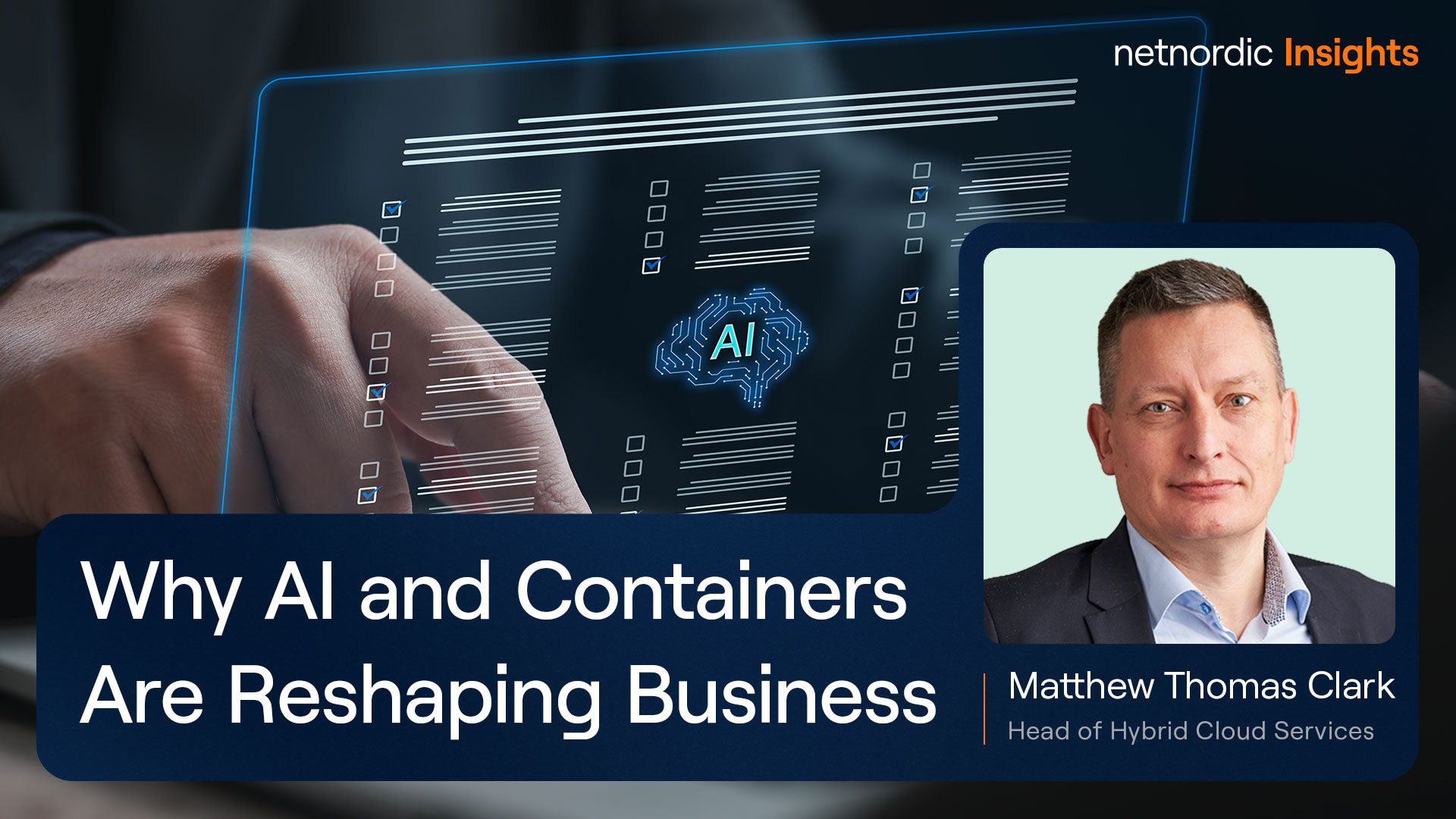
Artificial intelligence is no longer a futuristic concept. It is already embedded in tools that many companies use every day – from chatbots to productivity assistants. But while adoption appears widespread, understanding is often limited. At the same time, another technology – containers – is quietly reshaping how applications, including AI, are built and deployed. Together, AI and containers form the foundation of modern digital infrastructure. But to benefit from them, companies first need to understand what they are, why they matter, and how enterprise AI governance plays a critical role in ensuring they are used responsibly and effectively.
AI: More Than Chatbots and Copilots
When companies say they use AI, they often refer to tools like Microsoft Copilot or ChatGPT. These tools are useful, but they represent only a small part of what AI can do.
At its core, AI is about processing data. It can analyze large volumes of information, identify patterns, and automate tasks that would otherwise require significant manual effort. For businesses, this opens up opportunities to:
- Extract insights from data
- Improve decision-making
- Automate repetitive processes
However, many organizations struggle to move beyond simple use cases. The main reason is not a lack of technology, but the uncertainty about how to apply AI in a meaningful way.
The Challenge: Data and Control
AI relies heavily on data, and that data is often sensitive. In industries like healthcare or departments such as finance and HR, information can include patient records, financial data, or confidential employee details. This creates a major challenge when using AI services hosted in the public cloud, and “many companies simply can’t use public AI solutions because they can’t guarantee where their data ends up,” says Matthew Clark, Hybrid Cloud Services at NetNordic. Many widely available AI solutions operate in global environments where it is not always clear where the data is stored, how it is processed, and whether it leaves regional boundaries.
For European companies in particular, this raise concerns around GDPR compliance, data sovereignty and Schremms ii. Even large providers may not be able to guarantee that data stays within the EU. As a result, companies are cautious. They see the potential of AI but hesitate to fully adopt it due to security and compliance risks.
From General AI to Specialized AI
Another important distinction is between general and specialized AI. General models, such as ChatGPT, are designed to handle a wide range of questions. They are flexible but not tailored to specific industries.
In contrast, specialized AI models are trained for particular use cases such as analyzing medical data or supporting financial decisions. These models provide more accurate results, use resources more efficiently, and reduce exposure to irrelevant or external data. This shift towards more focused AI solutions is becoming increasingly important as companies look to apply AI in real business contexts.
What Are Containers?
While AI often gets the most attention, it depends on the underlying infrastructure to function effectively. This is where containers come in. A container is a way of packaging an application together with everything it needs to run: code, libraries, and configuration. This ensures that the application behaves the same way regardless of where it is deployed. In simple terms, containers allow applications to be:
- Portable (they can move between environments)
- Scalable (they can easily handle more or less demand)
- Consistent (they run reliably across systems)
Containers have become a standard in modern cloud environments, especially for applications that need flexibility and speed.
Why Containers Matter for AI
AI workloads are often complex and resource intensive. They require environments that can scale quickly and adapt to changing needs. Containers make this possible. By packaging AI models and services into containers, companies can deploy AI solutions faster, scale them up or down depending on demand, and move them between public and private environments.
This is particularly important for organizations that want to combine innovation with control. For example, a company might develop AI solutions in a public cloud environment but run them in a more secure, private setup. Containers make that transition possible without rebuilding the entire system.
A Shift from Traditional IT
The rise of containers reflects a broader shift in how IT systems are designed. In the past, companies relied on dedicated servers for each application. These servers often ran below capacity, leading to inefficiencies. Containers change this model by breaking applications into smaller components. Each component uses only the resources it needs, resulting in less waste, faster deployment, and improved security. For AI, which often involves processing large amounts of data, this more efficient architecture is a significant advantage.
Why Companies Need to Act Now
Despite the complexity, one thing is clear: AI and containers are not optional technologies, and “if you’re not looking at AI and containers, there’s a real risk your competitors are”, says Matthew Clark. Companies that fail to explore AI risk falling behind competitors who are already using it to improve efficiency and gain insights.
At the same time, modern infrastructure – enabled by containers – is becoming essential for building scalable and secure systems. The risks of doing nothing are falling behind in innovation, increased exposure to security threats, and higher long-term costs due to inefficient systems.
However, the challenge for many organizations is navigating the noise. AI is surrounded by hype such as online demonstrations, social media trends, and bold claims. But not all of it is relevant to every business. To move forward, companies need to focus on their own needs:
- What data do you have?
- What level of control do you require?
- What problems are you trying to solve?
Only then can you determine how AI and containers fit into your company’s strategy.
Creating a Foundation for the Future
AI and containers are often discussed separately, but their real value emerges when they are combined. AI provides the intelligence, while containers provide the flexibility, scalability, and control needed to run it securely across different environments. For organizations looking to move beyond experimentation, this combination forms the foundation of a modern, future-ready IT platform.
But technology alone is not enough. Success depends on making the right architectural choices, ensuring proper data governance, and establishing strong enterprise AI governance practices that align with business goals and regulatory requirements.
This is where having an experienced partner becomes essential. With deep expertise in AI, container-based platforms, and secure private cloud environments, NetNordic supports companies in designing, building, and scaling solutions in a controlled, data-sovereign Nordic setup. By combining technical capability with practical experience, NetNordic helps organizations move from uncertainty to execution, turning AI from a buzzword into real, measurable value.
Author

About Matthew Clark
Get in touch
Fill in the form and we will get back to you as soon as possible! Thanks!