Why human error in cybersecurity remains the biggest risk

Cybersecurity is often seen as a technical challenge, but in reality, it’s just as much a human one. While organisations invest heavily in tools and infrastructure, attackers continue to succeed by exploiting something far simpler: how systems are used, how people behave, and where small gaps are left unnoticed.
To truly understand where risk comes from, it’s not enough to look at technology alone. You need to understand how attackers think, how they approach systems, and why they succeed.
How hackers think: inside the mindset of modern cyber attacks
To understand cybersecurity, you first have to understand the attacker. The biggest mistake organisations make is assuming that hackers rely on highly advanced, complex techniques. In reality, most attacks succeed not because systems are weak, but because people, processes, or small oversights create opportunities.
"If one door is locked, they just move on to the next.
 Eirik Hole, Lead Security Consultant
Hackers don’t think in terms of targets. Instead, they think in terms of access. They scan broadly, test systems, and look for anything that works. If one path is blocked, they simply move on. It’s less like a carefully planned heist and more like walking down a street trying door handles. “If one door is locked, they just move on to the next,” explains Eirik Hole, Lead Consultant for Offensive Security at NetNordic. “They don’t need to break in everywhere – just find one place that works.”
They don’t break systems but find weaknesses
A common misconception is that hackers “break in” through force. More often, they don’t need to. Instead, they look for the weakest link in a chain that is otherwise secure. This could be an overlooked system, a misconfiguration, or a forgotten part of the infrastructure.
In many cases, it’s not even a technical flaw at all. Hackers understand that organisations are complex and constantly evolving, and that something is almost always left exposed. “The larger and older an organisation is, the more likely it is that something has been forgotten or left behind,” says Hole.
Once they find a way in, they don’t stop there. Access is only the beginning. From an attacker’s perspective, the real goal is to move further: across systems, between accounts, and deeper into the organisation. A single compromised account can lead to much broader access if the environment allows it.
People are the easiest entry point
Despite advances in security technology, humans remain the most reliable way in. In fact, human error in cybersecurity is still one of the leading causes of data breaches. Hackers know that it is often far easier to trick a person than to bypass a system, and phishing emails are still one of the most effective tools because they exploit everyday behaviour. People are busy, they take shortcuts, and they don’t always question what looks familiar. A well-crafted message only needs to convince one person to succeed.
In large organisations, this becomes even more predictable. With enough users, someone will eventually click, reuse a password, or store sensitive information in the wrong place.
"With many users, the probability is high that someone will make a mistake – and that's all an attacker needs"
Eirik Hole, Lead Security Consultant
Hackers rely on this probability. They don’t need everyone to make a mistake. Just one is enough.
Hackers exploit how organisations actually work
Beyond individual users, attackers also exploit how organisations operate on a broader level. They know that systems are often launched before security is fully considered, and that quick fixes are applied under pressure. Security is frequently treated as a cost rather than a necessity, which leads to compromises.
They also know that when security becomes too restrictive, people find ways around it. If a process is too slow or complicated, users will create their own shortcuts. From a hacker’s perspective, these workarounds are opportunities.
Even seemingly harmless information can be useful. Internal documents, emails, or small pieces of data can help map out systems or make future attacks more convincing. Hackers don’t just look for what is valuable – they use what is available.
AI is changing the scale, not the mindset
Artificial intelligence has made attacks faster and more scalable, but it hasn’t fundamentally changed how hackers think. The same principles still apply: find weaknesses, exploit them, and move forward.
What AI changes is speed and accessibility. Tasks that once required time and expertise can now be automated. One person can run multiple attacks at once, analyse results, and adjust quickly. AI can also generate more convincing phishing messages, making it harder to distinguish between real and fake communication.
In many ways, AI currently behaves like a junior pentester. It is effective at launching a wide range of attacks and testing for known weaknesses, but it often lacks the ability to chain together more advanced, targeted attack paths. Instead, it tends to try many different approaches and see what works.
It is also important to consider cost. Running AI tools often comes with ongoing expenses, which in some cases may outweigh the benefits compared to relying on experienced human experts.
So, to be truly effective, AI still requires expert guidance. Skilled practitioners are needed to direct its efforts, interpret results, and refine strategies. Without that input, its impact can be limited.
Suggested reading: Penetration Testing – a Key to Digital Resilience
Attackers expect mistakes because they always happen
At the core of the hacker mindset is a simple assumption: no system is perfect. Hackers don’t need to defeat strong security everywhere. They just need to find where it fails once. Whether it’s a human error, an outdated system, or a misconfiguration, they expect that something, somewhere, has been overlooked.
This is why absolute security is impossible. The goal is not to eliminate all risk, but to reduce the likelihood of success and limit the impact when something does go wrong. Rather than relying on a single strong barrier, modern security is built on the principle of defense in depth. This means placing multiple layers of security controls throughout an IT environment. If one layer fails or is bypassed, others are still in place to detect, delay, or stop an attack.
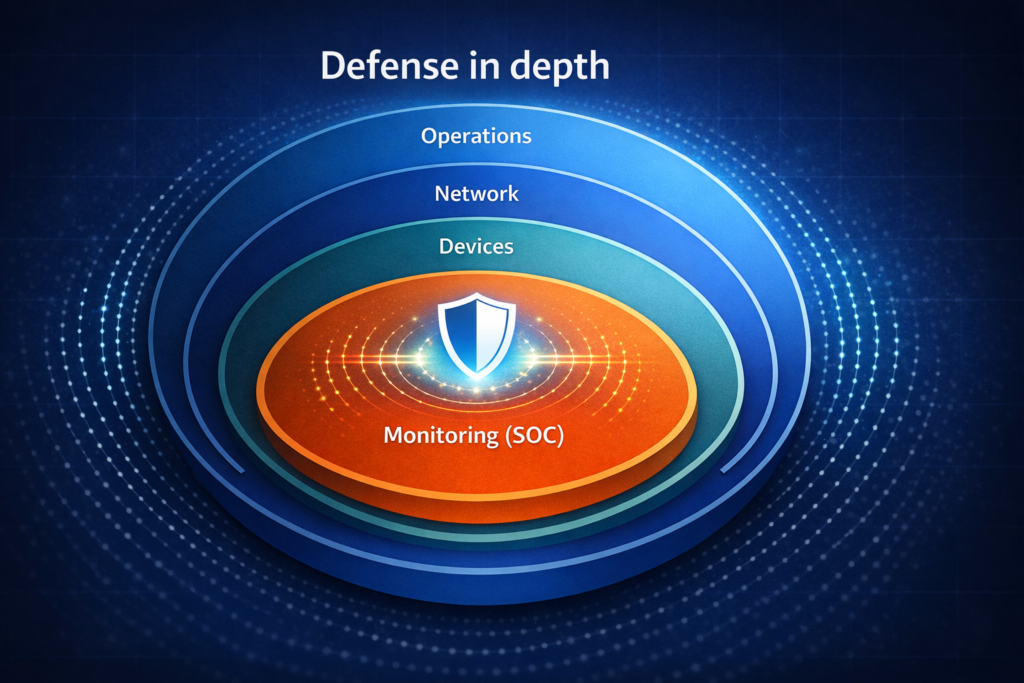
A useful way to think about it is to continuously ask: what happens if this layer fails? Building redundancy into security controls helps ensure that a single mistake does not lead to a full compromise.
In practice, that means focusing on a few key areas:
- Reducing the attack surface of your organisation, especially those involving users
- Continuously testing systems, rather than relying on one-time checks
- Treating security as a core part of operations, not an afterthought
- Implementing layered security controls with multiple checkpoints across systems and processes
This layered approach acknowledges that failures will happen, but ensures they do not immediately lead to success for an attacker.
Ethical hacking: testing before attackers do
One of the most effective ways to understand real risk is through ethical hacking. But what is ethical hacking? It is the practice of simulating real-world attacks in a controlled and legal way to uncover weaknesses before malicious actors do.
Ethical hackers use the same techniques as attackers, but with permission and a clear objective: to identify vulnerabilities and help organisations fix them. These exercises – often referred to as penetration testing or pentesting – provide insight into how systems, users, and processes behave under attack.
Rather than relying on assumptions, organisations gain a realistic view of where they are exposed and how those gaps can be closed.
Want to know more about cyber advisory? Please do not hesitate to contact us.
Strengthening security with NetNordic as your trusted partner
Understanding how attackers think is only the first step. Acting on that insight is what makes the difference. This is where NetNordic can be your trusted partner. With deep expertise in offensive security and penetration testing, NetNordic helps organisations uncover real vulnerabilities, prioritise what matters, and turn security from a reactive effort into a proactive strategy. In a landscape where attackers are constantly looking for the easiest way in, having the right partner ensures those opportunities are identified and closed before they can be exploited.
Eirik Hole
Lead Security ConsultantEirik Hole is a Security Consultant at NetNordic, specializing in offensive cybersecurity. He works hands-on with penetration testing, vulnerability assessments, and red team engagements, helping organizations uncover real-world weaknesses before attackers do. With over eight years of experience in cybersecurity, Eirik combines technical expertise with an attacker’s mindset—focusing not only on system vulnerabilities, but on how human behavior and process gaps can be exploited. He also has experience in incident handling and team leadership. Eirik is an active participant in Capture The Flag (CTF) competitions and is part of the Norwegian team RumbleInTheJungle, continuously sharpening his skills in realistic attack scenarios. His work is rooted in one principle: understanding how attackers actually gain access—and turning that insight into practical security improvements.
Table of Contents
- How hackers think: inside the mindset of modern cyber attacks
- They don’t break systems but find weaknesses
- People are the easiest entry point
- Hackers exploit how organisations actually work
- AI is changing the scale, not the mindset
- Attackers expect mistakes because they always happen
- Ethical hacking: testing before attackers do
- Strengthening security with NetNordic as your trusted partner
Content subjects category
Content type
Related content
Contact Us
Feel free to call us directly on our telephone number +47 67 247 365, send us an email salg@netnordic.no, or fill in the form and we will get back to you as soon as possible! Thanks!
Latest content
Inside the SOC at NetNordic: From Onboarding to 24/7 Protection

SOC, MDR, or XDR — What’s the difference, and what does your organization really need?
