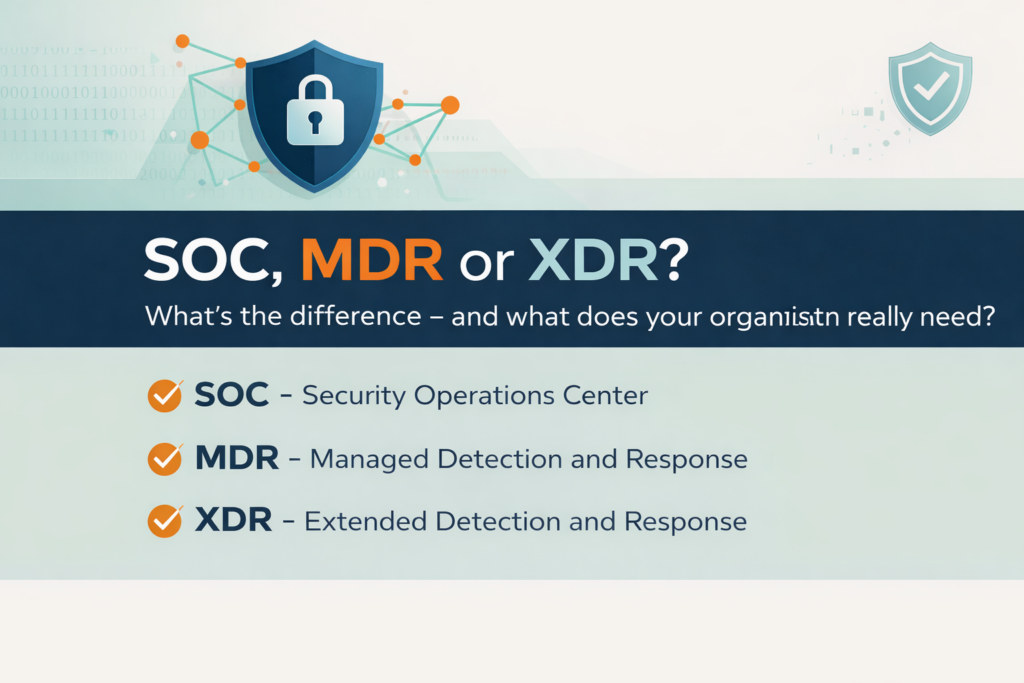
SOC, MDR, or XDR — What’s the difference, and what does your organization really need?

The conversation around cybersecurity has shifted from prevention to detection and response, but the terminology has not kept pace.
Organizations are presented with an expanding array of security services and platforms — yet not all of them solve the same problem.
As a result, many security leaders find themselves navigating a landscape where tools, services, and operational models are described interchangeably. The risk is not confusion over acronyms. The risk is investing in technology without clearly defining who owns detection, investigation, and response.
And in cybersecurity, ownership is everything.
The core question: Technology or operational capability?
Before comparing SOC, MDR, and XDR, it is important to understand one fundamental distinction:
Are you buying a technology platform — or establishing an operational security capability?
Technology generates signals.
Operational capability turns signals into decisions and action.
Many organizations believe they have “security coverage” because they have deployed advanced tools. But unless someone is continuously monitoring, correlating, validating, and responding, coverage is theoretical.
Security Operations Center (SOC): The Operational Backbone
A Security Operations Center (SOC) is not a product. It is a structured, accountable security function.
A mature SOC integrates:
- 24/7 monitoring
- Skilled analysts
- Incident response processes
- Threat intelligence
- Cross-domain log correlation
- Clear escalation and reporting structures
It ingests telemetry from endpoints, networks, cloud platforms, identity systems, and applications. It correlates signals across these domains, investigates anomalies, determines impact, and manages incidents through containment and remediation.
A SOC does not simply notify.
It owns detection and response.
For organizations operating critical infrastructure, regulated environments, or complex hybrid IT/OT architectures, this operational ownership becomes decisive.
Managed Detection and Response (MDR): Expert Monitoring as a Service
Managed Detection and Response (MDR) is a managed security service that combines detection technology — often endpoint-focused — with external expertise.
An MDR provider:
- Monitors alerts continuously
- Investigates suspicious activity
- Provides or executes response actions
- Delivers reporting and advisory support
MDR is particularly valuable for organizations that:
- Lack internal cybersecurity resources
- Need to raise detection maturity quickly
- Prefer outsourcing operational responsibility
However, MDR typically focuses on specific telemetry sources, such as endpoints. While highly effective within its scope, it may not always provide the same breadth of cross-domain visibility and contextual analysis as a fully integrated SOC capability.
The distinction is not about quality.
It is about scope and ownership.
EDR and XDR: Visibility platforms
Endpoint Detection and Response (EDR) is a technology deployed on endpoints to detect malicious or suspicious behavior using behavioral analytics and threat intelligence.
Extended Detection and Response (XDR) expands this model by aggregating telemetry from multiple sources — endpoints, network traffic, identity systems, cloud workloads, and email environments — into a unified detection platform.
Both significantly improve visibility.
But visibility is not the same as response.
EDR and XDR generate insights and alerts. They require operational context, investigation discipline, and decision-making authority to translate detection into risk reduction.
Without that operational layer, even advanced platforms risk becoming sophisticated alarm systems without accountability.
What this means for security leaders
The decision between SOC, MDR, and XDR is not about selecting the “most advanced” option. It is about aligning capability with risk exposure and organizational maturity.
Key questions to consider:
- Who owns detection and response today?
- Is monitoring continuous and accountable?
- Do we correlate across IT and cloud — and where relevant, OT?
- Are response processes defined, tested, and documented?
- Can we demonstrate this capability to regulators or boards?
For some organizations, MDR is the right and pragmatic step.
For others — particularly those facing regulatory pressure, complex hybrid architectures, or elevated threat exposure — a broader SOC capability becomes necessary.
In many cases, XDR and EDR serve as powerful enablers within either model — but they do not replace operational ownership.
The real differentiator: Accountability
Cybersecurity maturity is no longer defined by how many tools you deploy. It is defined by how quickly and confidently you can detect, understand, and contain an incident.
That requires clarity of responsibility.
The most resilient organizations are not those with the most dashboards. They are those with defined operational ownership of detection and response.
And that is the real difference behind the acronyms.

Table of Contents
Content subjects category
Content type
Related content

Contact Us
Feel free to call us directly on our telephone number +47 67 247 365, send us an email salg@netnordic.no, or fill in the form and we will get back to you as soon as possible! Thanks!